
Only 4.2% of Harrogate and Knaresborough Year 7s now get free school transport, the lowest in North Yorkshire. The consultation closes 4 November.
North Yorkshire Council has opened a consultation on its home to school travel policy, and the report behind it shows the change has hit Harrogate and Knaresborough harder than anywhere else in the county.
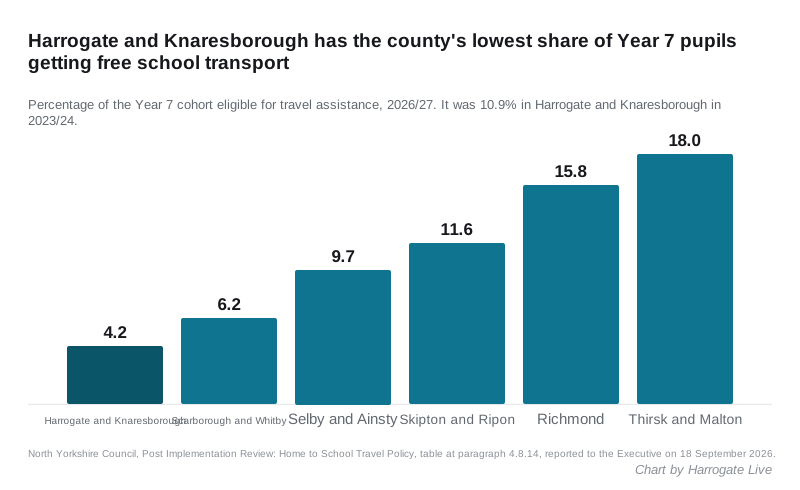
Just 4.2% of the Year 7 cohort at Harrogate and Knaresborough schools is eligible for travel assistance in 2026/27. That is the lowest figure of any area committee in North Yorkshire, and it is down from 10.9% in 2023/24, before the policy changed. The council’s post implementation review, reported to its Executive on 18 September, sets the figure out at paragraph 4.8.14.
The consultation opened on Monday 21 September and closes on Wednesday 4 November. Cllr Annabel Wilkinson, the executive member for education, learning and skills, said: “When the policy changed, we promised to review how it was working in practice and to listen to the experiences of families.”
What changed, and what it did here
The policy introduced in September 2024 made free travel depend on a child’s nearest school with a place, not a catchment school. The council says the service carries about 11,000 eligible pupils and costs more than £52 million a year (council announcement, 21 September).
In a town the size of Harrogate, where several secondary schools sit within a few miles of most homes, “nearest school” removes almost everybody from eligibility. The review’s own numbers show how far that has gone at Harrogate Grammar School:
- Seven Year 7 pupils were eligible for free transport in 2025/26, and seven again in 2026/27.
- In June 2025, paid travel arrangements accounted for 3 of the 56 Year 7 children being transported, 5.4%.
- By May 2026 they accounted for 32 of the 39, 82.1%.
- 72.7% of all Harrogate Grammar pupils on a paid travel pass are Year 7s.
Harrogate Grammar is the only one of the four case-study schools in the review where most Year 7s using school transport are now paying for it. It is also the only one of the four where the average journey for an eligible pupil has got longer, from 4.11 miles in 2023/24 to 4.98 miles in 2026/27, because the few who still qualify are the ones living furthest out.
The buses have shrunk to match. On Harrogate Grammar services, one contract went from a 33-seater to a 16-seater and another from a 6-seater to a 4-seater between June 2025 and May 2026, while a third went up from a 4-seater to a 6-seater. The number of children transported to the school fell from 319 to 282 over the same period. The review is careful here: it says the reductions cannot be attributed to the policy alone, because routine contract management, local population change and school preference all play a part.
The two Harrogate schools whose intake moved
The review singles out three secondary schools in North Yorkshire where Year 7 cohort size changed significantly over the period. Two of the three are in this district.
| School | 2023/24 | 2024/25 | 2025/26 | 2026/27 |
|---|---|---|---|---|
| Boroughbridge High School | 95 | 78 | 43 | 48 |
| Harrogate High School | 133 | 108 | 65 | 75 |
| Risedale School | 110 | 98 | 78 | 70 |
Boroughbridge High’s Year 7 intake fell by 35 pupils, about 45%, between 2024/25 and 2025/26. Harrogate High’s fell by 43 pupils, about 40%, over the same year. Both recovered slightly in 2026/27 but remain, in the review’s words, “significantly below the 2024/25 position”.
The report sets these out as observations alongside the policy change rather than as proven consequences of it, and does not attribute the cohort falls to the transport policy.
Ripon’s problem has a name in the report
The one issue in this district that the council has put to consultation against its own officers’ advice is shared drop-off points.
Under the 2024 policy, the nearest school is measured to the nearest defined school gate. Two schools can share a bus stop and still produce different answers. The review says nine Stage 2 appeals have been lodged on exactly this point, and names where it happens: Ripon Grammar School and Outwood Academy, Ripon, plus some drop-off points used by Richmond School and St Francis Xavier School.
Officers recommended keeping the policy as it is. Recommendation 11 in the report reads: “Retain the existing policy which does not consider shared drop-offs as a factor in determining the nearest school.” Their reasoning is that discretion here would create an extra expression of preference not available to families at schools without a shared stop, and would fall apart if a drop-off point moved.
The Executive asked for it to go into the consultation anyway. So the question is open, and Ripon families are the ones it was written about.
Officers also recommended no special treatment for selective grammar schools, on the grounds that the policy “should not give preference or advantage to any category of school”, and that doing so would set a precedent for faith schools and others.
What is actually being consulted on
The review made 24 recommendations. The Executive approved 10 on 18 September and noted seven more as already covered by the existing policy. The remaining seven go to full council in November, and those seven are what the consultation covers:
- greater discretion over the routes used to measure the way to a child’s nearest school
- whether to allow discretion where two schools share a drop-off point
- removing routes from the mapping system where it would be unreasonable for a pupil or a vehicle to use them
- clearer information about how home to school distances are measured
- removing five remote routes from the mapping system: Fleet Moss Road, Keld to Kirkby Stephen, Buttertubs Pass, The Stang and Kidstone Pass
- considering other routes for removal if the consultation identifies them as unsuitable
- clarifying that a pupil more than two miles from school under the age of 8, or more than three miles at 8 and over, is eligible and is not expected to walk in any capacity
The mapping problem is not theoretical. The review gives an example at Oughtershaw where the route the council’s system measured included a logging road that vehicles cannot use. It also records that route maps sent to parents during appeals carried the school’s UPRN co-ordinates in the system banner, which confused people, and that the council “has apologised to parents for any confusion that this has caused”. A replacement mapping system will be procured during 2027.
What it means for you
If you are applying for a secondary place this autumn, nothing has changed. The council is explicit that the current policy stands until decisions are made, and that families should make their school preferences on that basis. The secondary admissions deadline is Saturday 31 October.
Nothing agreed now affects a child starting in 2027 either. Any approved change takes effect no earlier than September 2027 and applies to children starting Reception and Year 7 in September 2028.
If you want to influence it, the window is six weeks. The consultation runs to Wednesday 4 November through the council’s survey. Paper copies are available in North Yorkshire libraries, and alternative formats on request. Full council takes the seven recommendations in November.
For what else the council is doing on the ground here, see our Harrogate roadworks and travel page and our Harrogate planning news.
Frequently asked questions
Who qualifies for free school transport in Harrogate now?
Eligibility is based on a child’s nearest school with a place available, not a catchment school. In practice that means very few Harrogate and Knaresborough families qualify: 4.2% of the Year 7 cohort in 2026/27, against 10.9% in 2023/24.
When does the North Yorkshire school transport consultation close?
Wednesday 4 November 2026. It opened on Monday 21 September and runs through the council’s online survey, with paper copies in libraries.
Does this change anything for a child starting secondary school in 2027?
No. The council says the current policy stands until decisions are made. Any approved change takes effect no earlier than September 2027 and applies to children starting Reception and Year 7 in September 2028. The secondary admissions deadline for next September is Saturday 31 October.
Will Ripon Grammar and Outwood Academy pupils be treated differently?
That is one of the seven questions in the consultation. Officers recommended keeping the current rule, which ignores shared drop-off points, but the Executive asked for it to be consulted on. Nine Stage 2 appeals have been lodged on the issue, and the review names Ripon Grammar School and Outwood Academy, Ripon, as where it arises.
Do grammar schools get an exception?
No, and the review recommends keeping it that way. Its reasoning is that the policy “should not give preference or advantage to any category of school”, and that an exception for selective schools would set a precedent for faith schools and others.
Sources
- Post Implementation Review: Home to School Travel Policy, report of the Assistant Chief Executive, Local Engagement, dated 16 September 2026 (eligibility by area committee at 4.8.14, Year 7 cohort table at 4.7.5, Harrogate Grammar distances, paid travel passes and vehicle sizes, recommendations R11 and R12, the Oughtershaw logging road and the UPRN apology)
- North Yorkshire Council Executive, 18 September 2026, agenda and reports
- Public to have say on home to school travel recommendations, North Yorkshire Council, 21 September 2026 (11,000 pupils, £52 million, the 24 recommendations split, Cllr Wilkinson’s quote, the five remote routes, the 2027 and 2028 dates)
- Have your say on proposed changes to our home to school travel policy, the consultation page, closing 4 November 2026
- Our earlier report: North Yorkshire school transport: nearest-school rule stays
Have your say