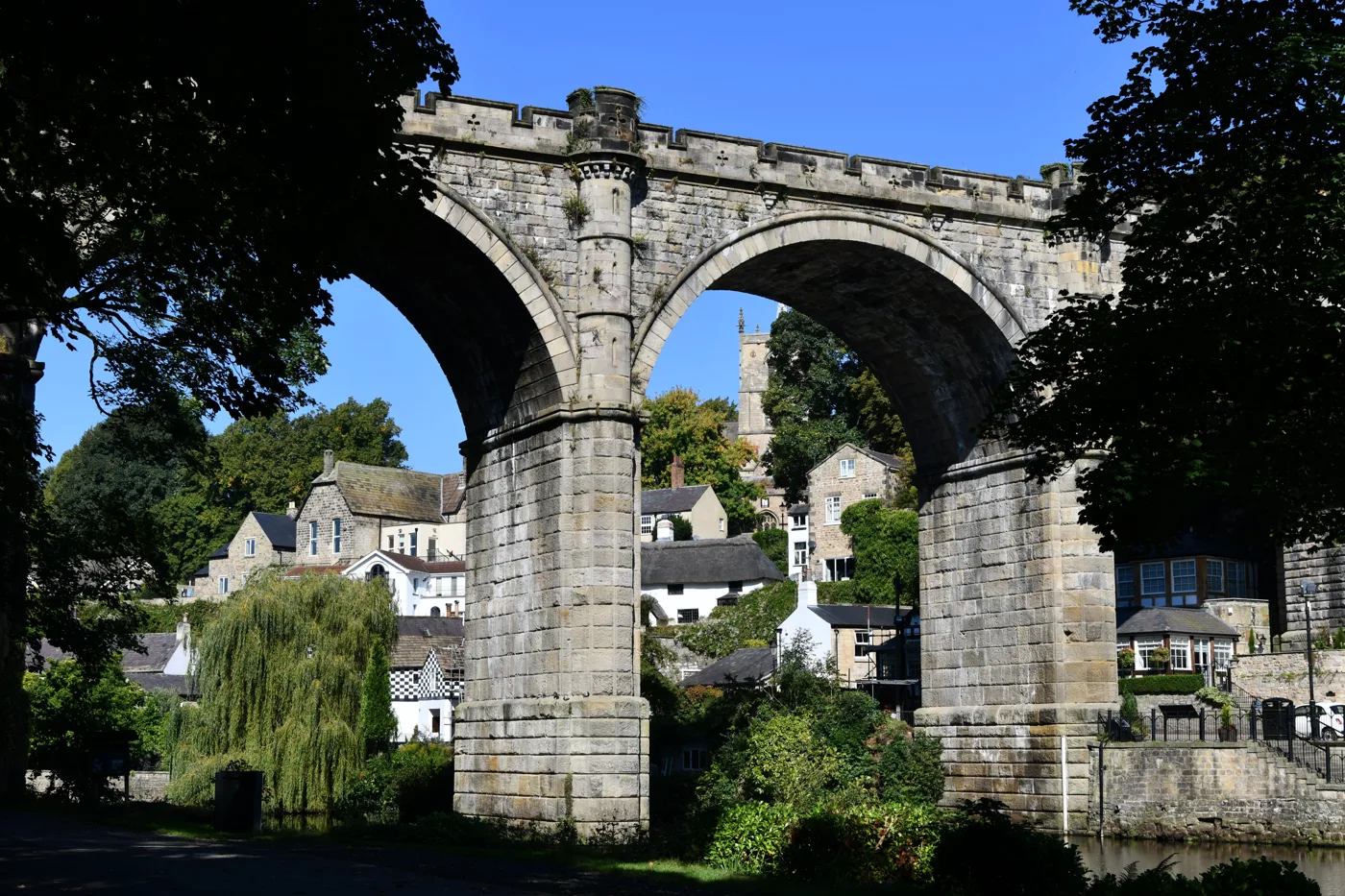

Knaresborough's Viaduct Terrace cannot be repaired before summer 2027, the council says, and only if a capital bid wins. Petition debated 24 September.
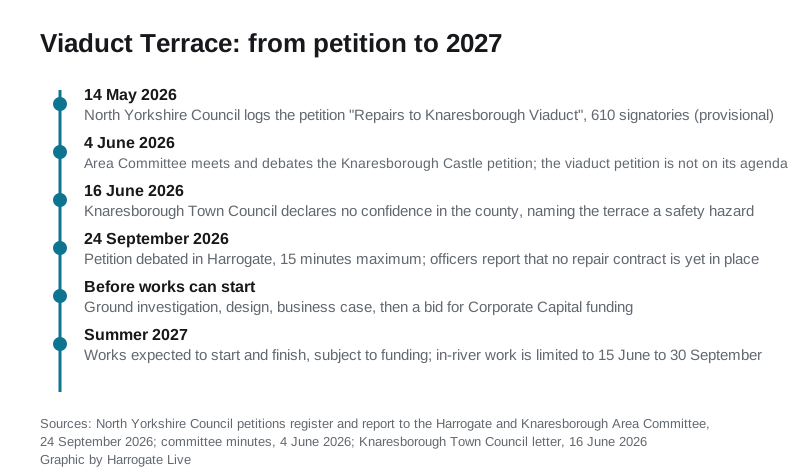
Repairs to the collapsed Viaduct Terrace in Knaresborough are not expected to start until summer 2027, and the money for them has not been applied for yet. That is what North Yorkshire Council officers have put in writing, in the report that answers the petition on the subject, published this week ahead of a debate in Harrogate next Thursday.
The report is the council’s formal response to a petition it registered as “Repairs to Knaresborough Viaduct”. It goes to the Harrogate and Knaresborough Area Committee on Thursday 24 September.
Three things in it have not been widely reported, and each one matters more than the 2027 date itself.
1. There is no contract yet, and the first attempt failed
The council says a contract “is in the process of being awarded” for the reconstruction. It is not a contract to rebuild the wall. It is a contract to find out what is under it, through what officers call Early Contractor Involvement and ground investigation:
- cores drilled to prove the depth of the viaduct’s foundation
- boreholes to establish ground conditions near the wall that has to be rebuilt
Those results then inform the design, and the design informs the business case.
The council also records, in a single sentence, why this has taken so long: “Initial attempts to get quotes for ground investigation was unsuccessful, with no quotes received.” Nobody bid. The report gives the reason as the liabilities and risk of working on and close to Network Rail infrastructure, meaning the live railway and the viaduct carrying it. The council’s answer is to engage a principal contractor directly so that the risk is carried by them.
2. The 2027 date depends on money that has not been granted
The officers’ wording is conditional, and the condition is the important part. The design leads to a business case, which “will subject to a bid for Corporate Capital funding through the council’s financial governance procedures”. Only then: “Subject to the approval of funding, works are expected to start in summer 2027 and be completed the same year.”
So summer 2027 is not a start date. It is the earliest start date available if the investigation, the design, the business case and a competitive bid for capital money all succeed in turn. The report’s financial section says the same thing in one line: the capital budget “will be subject to a bid”.
3. Summer is not a choice, it is the in-river window
The reason the work cannot simply be done in the winter the petitioners are worried about is ecological. The report explains that “due to fish migration and spawning, works in rivers are generally undertaken between the 15 June and the 30 September”.
That is a window of about 15 weeks a year. Miss it in 2027 and the next one opens in June 2028.
What the petition actually asked for
The petition text, set out in full in the council’s report, asks the council to “reclassify the Viaduct Terrace landslip as an urgent priority and begin meaningful stabilisation works before the onset of winter weather”. It warns of a “winter washout” and says delay “risks significantly greater erosion, turning a manageable project into a multi-million-pound disaster”.
The council’s petitions register records the petition as received on 14 May 2026 with 610 signatories (provisional). That is the number that counts under the council’s rules: only people who live, work or study in North Yorkshire may sign, and 500 valid signatures is what triggers a debate at an area committee. Higher totals have circulated elsewhere, but the register is the count that governs what happens next.
The council’s report does not say when the terrace failed.
Four months from receipt to debate
The petition was registered on 14 May. The Area Committee’s next meeting was on 4 June, and its minutes show it received a different Knaresborough petition that day, about the castle. The viaduct petition was not on that agenda. It now arrives on 24 September, more than four months after the council logged it, and six days before this year’s in-river working season closes.
The committee cannot order the work
This is the part that will frustrate people in the public gallery. The report tells members plainly that two of the four possible responses to a petition are closed to them: “It is not possible to select Options 1 or 2, as the decision is not within the competence of the Harrogate and Knaresborough Area Committee.”
What the committee can actually do on Thursday:
- refer the matter to an overview and scrutiny committee for further investigation
- write its own report to the decision maker, with recommendations
- note the report and take no further action
The debate is capped at 15 minutes. The petition organisers get five minutes to present it first.
The town council got there in June
Knaresborough Town Council has already run out of patience with the county, and Viaduct Terrace is one of the reasons it gave. On 16 June it sent a formal vote of no confidence to North Yorkshire Council’s chief executive Richard Flinton and its leader Carl Les, signed by town clerk Angela Pulman.
The letter lists the terrace alongside Knaresborough House, the castle, the Waterside public toilets, the paddling pool and the town’s historic setts. On the terrace it says: “Long-term neglect has resulted in structural failure, creating both an immediate safety hazard and a damaging visual blight.”
It then demands “an immediate and substantial capital investment package”, and asks the county to begin negotiating a devolution deal so that the assets and the money to maintain them pass to the town council instead.
What is actually at risk
The structure above the terrace is not an ordinary railway bridge. Historic England lists it at Grade II*, the middle of the three listing grades and a step above the ordinary Grade II. It was listed on 15 May 1968.
The listing describes a gritstone viaduct of 1851, by the engineer Thomas Grainger for the Leeds and Thirsk Railway, roughly 100 metres long and 30 metres high, carrying two tracks on four arches. The two central arches span the river. The two flanking arches span the Long Walk on the south bank and Waterside on the north, which is the side where the terrace has gone.
The listing also records what happened the first time: work began in 1847, the bridge collapsed in 1848, and the replacement cost £9,803.
What it means for you
If you want to be heard on this, the deadline is Monday and it is strict.
- To speak at the meeting, you must give notice, including the text of your question or statement, to Edward Maxwell in Democratic Services by midday on Monday 21 September. Each speaker gets three minutes.
- To watch, the meeting is at 10am on Thursday 24 September in the Council Chamber at the Civic Centre, St Luke’s Avenue, Harrogate, HG1 2AE.
- To read it first, the full agenda and every report are on the council’s meeting page.
Two of the committee’s own members represent the town: Councillor Hannah Gostlow, who sits for Knaresborough East and is the committee’s vice-chair, and Councillor Matt Walker, who sits for Knaresborough West. Both are Liberal Democrats. The committee is chaired by Councillor Peter Lacey.
We will report what the committee decides. For other work affecting getting around the district, see our Harrogate roadworks and travel page, and for applications near the river, our Harrogate planning news.
Have your say