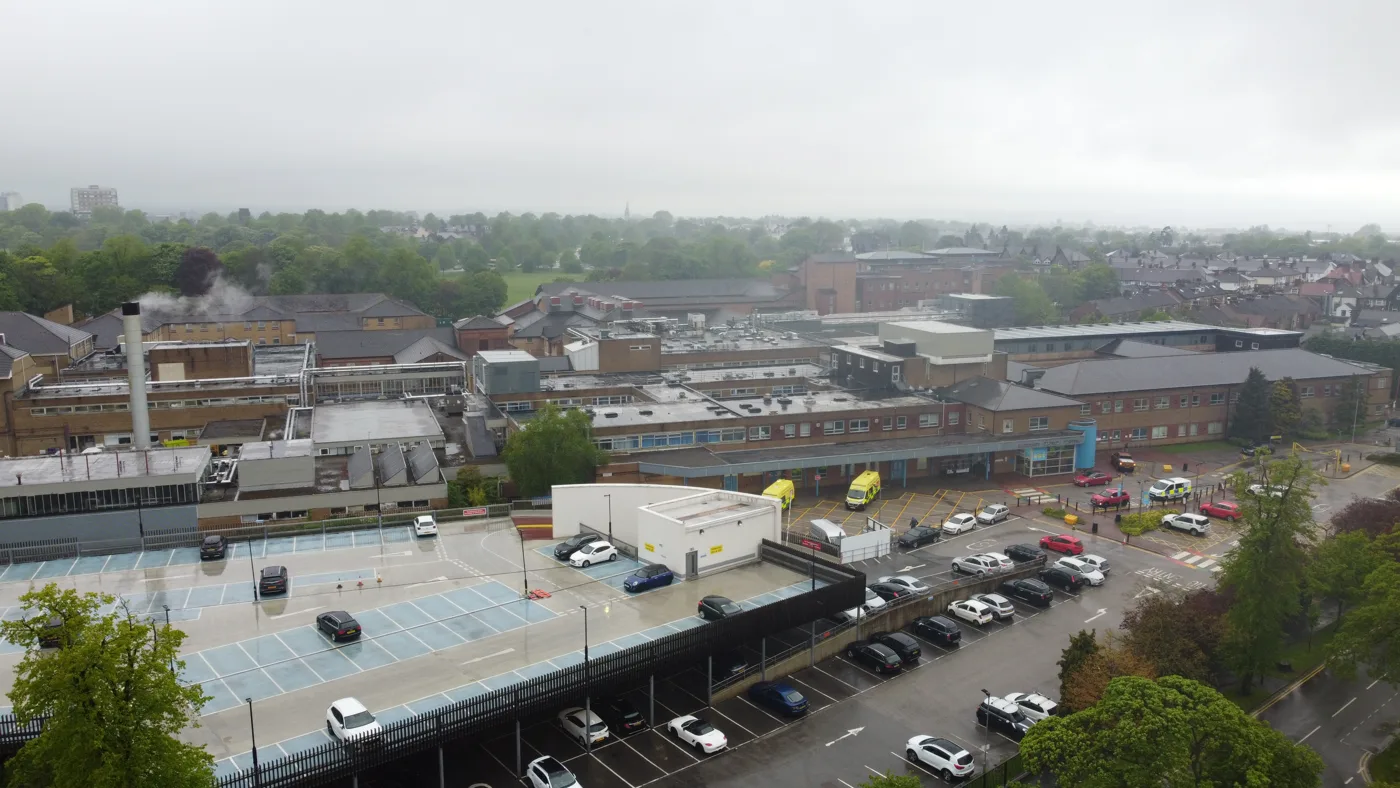

A shared heat network could link Harrogate District Hospital and about 80% of homes in Fairfax. Residents can give their views at two drop-ins on Thursday 19 November.
Harrogate Town Council is asking Fairfax residents whether they would want their homes heated by a shared heat network. A study is now looking at a network that could link Harrogate District Hospital, social housing and about 80% of homes in the area.
Residents can find out more at two drop-in sessions on Thursday 19 November. There is no need to book. The council announced the sessions on 11 November.
Overview
- What: a feasibility study into a low-carbon heat network for Fairfax, run by the engineering firm Buro Happold for Harrogate Town Council.
- Where it could reach: from the St Andrews estate towards Walworth Avenue in the north-east and Stonefall Drive in the south-east, including the hospital.
- Drop-ins, Thursday 19 November: 2.30pm to 5pm at Harrogate Town Football Club, and 5.30pm to 8pm at the Fairfax Community Wellbeing Hub.
- Nothing is decided. The council says no decision has been made to build a network.
Where and when to go
| Time | Venue |
|---|---|
| 2.30pm to 5pm | Harrogate Town Football Club, Wetherby Road, HG2 7SA |
| 5.30pm to 8pm | Fairfax Community Wellbeing Hub, Fairfax Avenue, HG2 7RU |
Both are on Thursday 19 November. Residents can also fill in a short online survey. People who take part can enter a prize draw for a £100 Harrogate gift card. The council has not given a closing date for the survey.
From three areas to one
The study started with three priority residential areas: Bilton, Fairfax and Jennyfield. Together they held about 2,350 households, the town council says. It has now narrowed the work to Fairfax alone.
The aim of the original bid was to see whether low-carbon heating could help households in fuel poverty. The town council won £39,943 from the Great British Energy Community Fund for the early-stage work, with support from the North East and Yorkshire Net Zero Hub. Buro Happold was appointed after a public procurement.
The study covers:
- how much heat the area needs, and where it could come from
- possible pipe routes and sites for an energy centre
- high-level costs, and the technical, economic and environmental modelling
- the risks and benefits
- whether the community could own the network
- where money to build and run it might come from
- what, if anything, should happen next
What a heat network would mean for a home
A heat network makes heat in one central place and sends it to buildings through underground pipes. A home would swap its boiler for a compact heat interface unit, the council explains. Radiators and hot water would work in much the same way as now. Each home would keep its own thermostat and have its own heat meter.
The benefits being tested include more predictable heating costs, less reliance on individual boilers and lower-carbon heat. The council stresses that the current work is only to test whether a network would be viable and worthwhile.
There are more than 14,000 heat networks in the UK, serving around 500,000 households, according to the council. They supply about 3% of the country’s heat. The national aim is for that to reach about 20% by 2050.
What it means for you
- If you live in Fairfax, this is the stage where residents’ views shape the study. Drop in on 19 November or use the survey.
- Nothing changes in your home yet. No network has been approved, and the council says any future scheme would need the support of the community it serves.
- If you live in Bilton or Jennyfield, those areas are no longer part of the study.
- The finished study will set out recommended next steps. We will report what it says.
Have your say